Music and the Catholic faith have been intertwined since the earliest days of the Church. From the psalms chanted by the apostles to the soaring polyphony of Renaissance cathedrals, from the quiet contemplation of Gregorian chant to the joyful exuberance of modern worship music, the Catholic tradition of sacred music is one of the richest artistic and spiritual heritages in human history. Sacred music is not mere decoration or entertainment added to the liturgy; it is, as the Second Vatican Council declared, "a necessary and integral part of the solemn liturgy." In this article, we will journey through the history of Catholic sacred music, examine its theological foundations, explore the different forms it has taken over the centuries, and consider how music continues to play a vital role in retreats, prayer, and the spiritual life of the faithful today.
The Biblical Foundations of Sacred Music
The roots of Catholic sacred music reach back to the very beginning of salvation history. The Scriptures are filled with songs, hymns, and musical expressions of praise. The Book of Psalms, the great hymnbook of ancient Israel, contains 150 songs that have been prayed and sung by the people of God for over three thousand years. These psalms express the full range of human emotion before God: praise and thanksgiving, lament and sorrow, petition and trust, wonder and awe.
"Sing to the Lord a new song; sing to the Lord, all the earth. Sing to the Lord, praise his name; proclaim his salvation day after day." (Psalm 96:1-2)
Music appears at pivotal moments throughout the Old Testament. After the crossing of the Red Sea, Moses and Miriam led the Israelites in a great song of triumph and thanksgiving (Exodus 15). King David, the greatest musician of Israel, danced before the Ark of the Covenant and established elaborate musical worship in the Temple, appointing Levitical choirs and orchestras. The prophets often delivered their messages in poetic, musical form, and the wisdom literature is saturated with musical imagery.
In the New Testament, we find that Jesus Himself sang. The Gospel of Matthew tells us that after the Last Supper, Jesus and His disciples "sang a hymn" before going out to the Mount of Olives (Matthew 26:30). This was almost certainly the Hallel psalms, the traditional songs of Passover. Saint Paul exhorted the early Christians to address "one another in psalms, hymns, and spiritual songs, singing and making melody to the Lord with your heart" (Ephesians 5:19). The Book of Revelation gives us a glimpse of the heavenly liturgy, where angels and saints sing ceaseless praise before the throne of God: "Holy, holy, holy is the Lord God Almighty, who was, and is, and is to come" (Revelation 4:8).
From these biblical foundations, the Church understood from the very beginning that music is not optional in worship but essential. It is one of the primary ways human beings express their relationship with the divine, lifting the heart and mind to God in a manner that mere spoken words cannot fully achieve.
The Early Church and the Birth of Chant
In the first centuries of Christianity, the faithful gathered in homes, catacombs, and eventually in basilicas to celebrate the Eucharist and pray the Liturgy of the Hours. Their worship was marked by the singing of psalms, hymns, and canticles. The early Church Fathers wrote extensively about the power of sacred music. Saint Augustine, who was famously moved to tears by the hymns he heard in the cathedral of Milan, wrote in his Confessions of the profound effect that sacred music had on his conversion. He observed that through beautiful singing, "the truth would more easily penetrate my mind," acknowledging both the beauty and the spiritual danger of becoming too attached to the music itself rather than to the God it glorifies.
Saint Ambrose of Milan is often credited with introducing antiphonal singing and structured hymnody into the Western Church. His hymns, composed in simple, dignified Latin verse, were designed to teach doctrine and inspire devotion. Many of them are still sung today. The Ambrosian chant tradition that bears his name is one of the oldest liturgical music traditions in the West, predating Gregorian chant and still practiced in the Archdiocese of Milan.
During these early centuries, different regional traditions of liturgical chant developed across the Christian world. The Byzantine tradition in the East developed its own rich system of eight musical modes and elaborate hymnography. In the West, various chant traditions emerged: Old Roman chant, Ambrosian chant, Mozarabic chant in Spain, and Gallican chant in France. Each of these represented a local community's way of singing the faith, shaped by the language, culture, and musical sensibilities of the people.
Gregorian Chant: The Golden Standard
The tradition that came to dominate Western Catholic worship, and which the Church has consistently held up as the model of sacred music, is Gregorian chant. Named after Pope Saint Gregory the Great (reigned 590-604), though the attribution is partly legendary, Gregorian chant represents the synthesis and codification of earlier Roman and Frankish chant traditions. By the eighth and ninth centuries, Gregorian chant had been standardized and spread throughout the Carolingian Empire, becoming the universal musical language of the Roman Rite.
Gregorian chant is monophonic, meaning it consists of a single melodic line without harmony or accompaniment. It is sung in Latin, the sacred language of the Roman Rite, and its rhythms are derived from the natural cadences of the Latin text. The melodies range from the simplest syllabic settings, where each syllable receives one or two notes, to elaborate melismatic passages where a single syllable may be extended over dozens of notes in cascading waves of melody.
The beauty of Gregorian chant lies in its simplicity and its transparency. It does not draw attention to itself or to the performers; rather, it serves as a vehicle for the sacred text, carrying the words of Scripture and prayer on waves of melody that seem to lift them beyond the merely human and into the realm of the divine. The Second Vatican Council recognized this when it affirmed that Gregorian chant is "specially suited to the Roman liturgy" and should be given "pride of place" in liturgical celebrations (Sacrosanctum Concilium, 116).
The chant tradition is intimately connected with monastic life. For centuries, monasteries were the primary centers of chant performance and preservation. The monks and nuns who chanted the Divine Office seven or eight times each day lived lives entirely structured around the liturgical singing of the psalms. The abbey of Solesmes in France, under the leadership of Dom Prosper Gueranger in the nineteenth century, led a great revival of Gregorian chant, painstakingly reconstructing the ancient melodies from medieval manuscripts and establishing performance practices that are still followed today.
Polyphony and the Flowering of Sacred Art
While Gregorian chant remained the foundation of Catholic liturgical music, the medieval period saw the gradual development of polyphony, the art of combining multiple independent melodic lines simultaneously. Beginning with simple organum in the ninth and tenth centuries, where a second voice was added to the chant melody, polyphonic music grew increasingly sophisticated over the following centuries.
The great cathedrals and collegiate churches of the twelfth and thirteenth centuries, particularly Notre-Dame de Paris, became centers of musical innovation. Composers like Leonin and Perotin created elaborate polyphonic settings that transformed the sound of worship, adding layers of harmonic complexity to the ancient chant melodies. The motet, a new form of sacred composition, emerged during this period and would remain one of the most important genres of sacred music for centuries to come.
The Renaissance, from roughly the fifteenth to the early seventeenth century, represented the golden age of Catholic polyphony. Composers such as Josquin des Prez, Orlando di Lasso, Tomas Luis de Victoria, and above all Giovanni Pierluigi da Palestrina created works of such sublime beauty that they are still regarded as the pinnacle of sacred vocal music. Palestrina, in particular, holds a special place in Catholic musical history. According to tradition, his Pope Marcellus Mass demonstrated that polyphonic music could be both artistically sophisticated and textually clear, thereby convincing the Council of Trent not to ban polyphony from the liturgy.
The Council of Trent (1545-1563), responding to Protestant criticisms and genuine abuses in liturgical practice, issued guidelines for sacred music that emphasized the primacy of the sacred text and the importance of intelligibility. While the Council did not ban polyphony, it called for music that was dignified, devout, and that served the worship of God rather than the display of human skill. These principles have continued to guide the Church's approach to sacred music down to the present day.
The Baroque, Classical, and Romantic Periods
The centuries following the Council of Trent saw an explosion of sacred musical creativity. The Baroque period (roughly 1600-1750) brought dramatic new forms of sacred music, including the oratorio, the sacred cantata, and elaborate settings of the Mass and other liturgical texts. While Johann Sebastian Bach, a Lutheran, is perhaps the most famous sacred composer of this era, Catholic composers such as Antonio Vivaldi, Marc-Antoine Charpentier, and Heinrich Biber created works of extraordinary beauty and devotion. The great Baroque organs, with their multiple manuals and rich tonal palettes, became fixtures of Catholic worship, and the organ has remained the pre-eminent instrument of the Roman liturgy.
The Classical period brought composers like Wolfgang Amadeus Mozart and Joseph Haydn, whose Mass settings, requiems, and other sacred works combined formal elegance with genuine religious feeling. Mozart's Requiem, left unfinished at his death, remains one of the most performed and beloved sacred works in the repertoire. Ludwig van Beethoven's Missa Solemnis, though rarely used in actual liturgical settings due to its length and difficulty, is one of the most profound musical meditations on the Mass texts ever composed.
The Romantic period saw a tension between two approaches to sacred music. On one hand, composers like Anton Bruckner, Charles Gounod, and Cesar Franck created large-scale sacred works that drew on the full resources of the Romantic orchestra and chorus. On the other hand, the Cecilian Movement of the nineteenth century advocated a return to the purity of Gregorian chant and Renaissance polyphony, viewing the theatrical excesses of Romantic sacred music as incompatible with true liturgical worship. This tension between musical innovation and liturgical propriety has been a recurring theme in Catholic sacred music throughout the centuries.
The Twentieth Century and the Second Vatican Council
The twentieth century brought sweeping changes to Catholic sacred music. Pope Saint Pius X's 1903 motu proprio Tra le Sollecitudini set out three qualities that sacred music must possess: holiness, beauty of form, and universality. It reaffirmed the primacy of Gregorian chant and classical polyphony while permitting more modern compositions that met these criteria. The document also called for the active participation of the faithful in the singing of the liturgy, a theme that would be developed more fully by the Second Vatican Council.
The Second Vatican Council (1962-1965) brought about the most significant changes to Catholic worship since the Council of Trent. The Constitution on the Sacred Liturgy, Sacrosanctum Concilium, affirmed the importance of sacred music in the strongest terms, calling it "a treasure of inestimable value, greater even than that of any other art." The Council called for the active participation of the faithful in the liturgy, including in the singing, and permitted the use of vernacular languages alongside Latin.
The implementation of these reforms, however, was often controversial. In many places, the transition from Latin to the vernacular was accompanied by a wholesale abandonment of the Church's musical heritage. Gregorian chant, Renaissance polyphony, and the great hymn traditions were often replaced by hastily composed songs of varying quality. The pipe organ was sometimes displaced by guitars, drums, and other instruments. Many Catholics mourned the loss of the Church's musical patrimony, while others welcomed the accessibility and vitality of the new music.
In the decades since the Council, the Church has sought to find a balance. Pope Saint John Paul II, Pope Benedict XVI, and Pope Francis have all emphasized the importance of maintaining the Church's musical heritage while also welcoming authentic new contributions to the tradition. Pope Benedict XVI, in particular, was a strong advocate for the restoration of Gregorian chant and sacred polyphony in the liturgy, viewing beautiful sacred music as an essential means of evangelization and catechesis.
Modern Catholic Music and Worship
Today, the landscape of Catholic sacred music is remarkably diverse. In many parishes, a blend of traditional hymns, contemporary worship songs, and chant is used. A vibrant movement of Catholic contemporary music has emerged, with artists and composers creating music that is both accessible to modern ears and rooted in Catholic theology and spirituality.
Contemporary Catholic musicians have drawn on a wide range of musical styles, from folk and acoustic to rock, pop, and even hip-hop, to communicate the faith to new generations. Organizations and movements dedicated to Catholic music have created communities of musicians and worshippers who seek to use music as a tool for evangelization and spiritual growth.
At the same time, there has been a remarkable revival of interest in the Church's older musical traditions. Gregorian chant recordings have become bestsellers, and many young Catholics are drawn to the beauty and contemplative depth of the chant tradition. Schola cantorum groups have been established in parishes and dioceses around the world, and chant workshops and festivals attract enthusiastic participants. The traditional Latin Mass, celebrated according to the 1962 Missal, has also experienced a resurgence, bringing with it the full musical heritage of Gregorian chant and classical polyphony.
Sacred music in the Catholic context today also extends beyond the Mass. Eucharistic adoration, prayer groups, retreats, and pilgrimages all provide contexts for musical worship. The Taize community, an ecumenical monastic community in France, has developed a distinctive style of meditative, repetitive chant that has been widely adopted in Catholic prayer settings. Praise and worship music, originally associated with Protestant charismatic movements, has been embraced by many Catholic charismatic communities and retreat centers.
Music at Retreats and Camps
Catholic retreats and camps occupy a special place in the relationship between music and faith. Away from the routines of daily life, retreatants have the opportunity to encounter God in a more intensive and focused way, and music plays a crucial role in creating the atmosphere for this encounter.
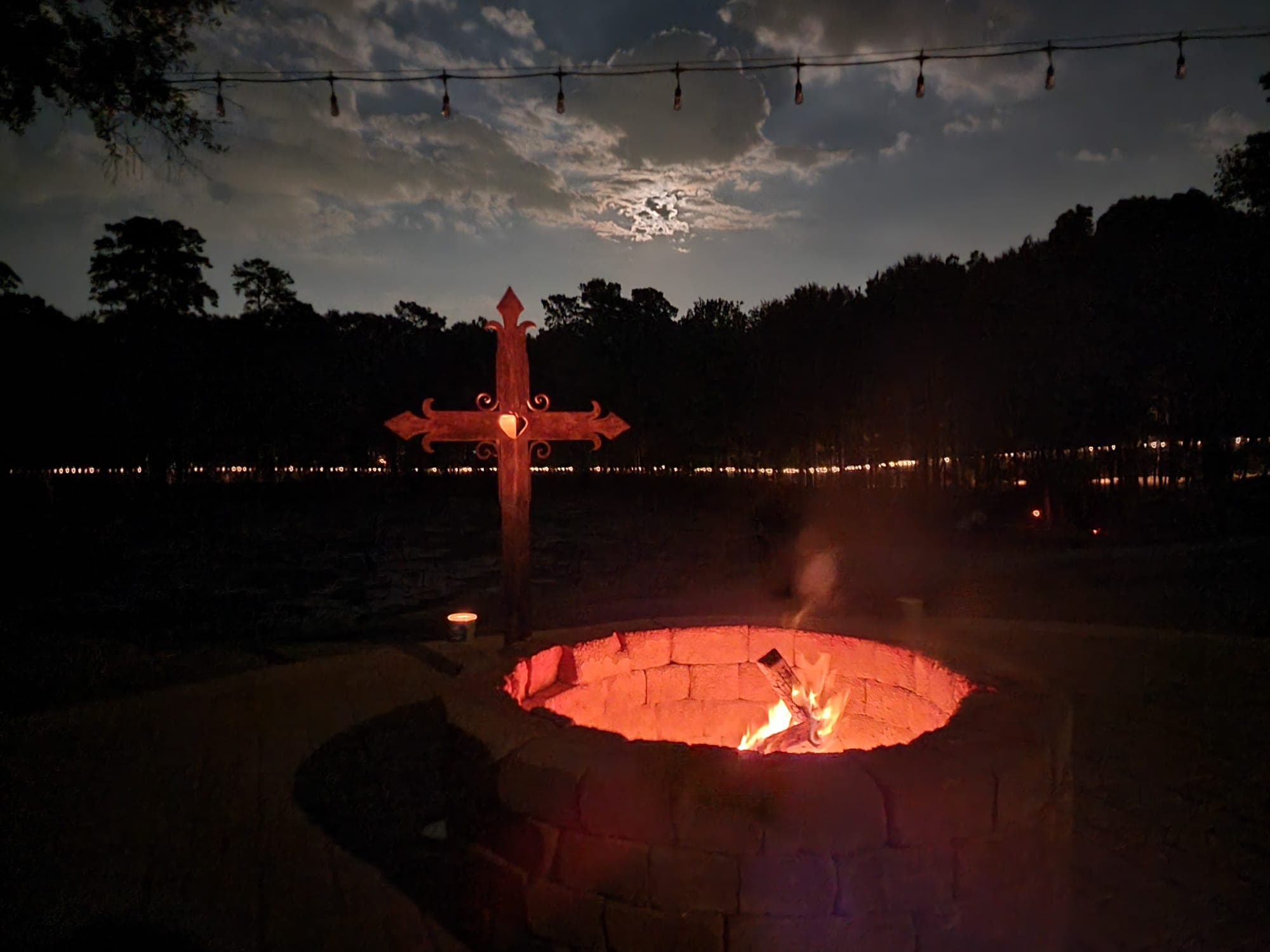
At Camp Deo Gratias, music is woven into the fabric of every day. Morning and evening prayer are accompanied by hymns and chants that set the tone for the day and bring it to a close in an atmosphere of peace and gratitude. Campfire worship, under the open sky and the light of the flames, provides a uniquely powerful setting for singing praise. There is something profoundly moving about lifting one's voice in song with fellow believers in the beauty of God's creation, surrounded by the natural world that itself sings His glory.
Music at retreats serves several important spiritual functions. First, it creates community. When people sing together, they experience a unity that goes beyond mere social bonding; they participate together in the act of worship, becoming one body praising one God. Second, music opens the heart to prayer. A well-chosen hymn or worship song can break through emotional defenses and intellectual barriers, allowing the Holy Spirit to work in ways that words alone cannot achieve. Third, music teaches. The great hymns of the Church are repositories of theological truth, and singing them imprints these truths on the mind and heart in a uniquely powerful way.
"He who sings, prays twice." This saying, often attributed to Saint Augustine, captures the essential truth that music elevates prayer, giving it wings that carry it beyond the merely verbal into the realm of the heart and the spirit.
Practical Guidance for Deepening Your Musical Prayer Life
For Catholics who wish to deepen their engagement with sacred music, there are many practical steps that can be taken. First, learn to listen. Spend time with the great works of Catholic sacred music, from Gregorian chant to Renaissance polyphony to the best of modern Catholic composition. Allow the music to wash over you, opening your heart to the beauty of God that it reflects.
Second, learn to sing. You do not need to have a trained voice to participate in the singing of the liturgy. The Church calls all the faithful to sing, not just the choir. Join in the hymns and responses at Mass with full voice and full heart. If your parish has a choir or schola, consider joining. If not, consider starting one.
Third, pray with music. Incorporate sacred music into your personal prayer life. Listen to chant or sacred polyphony during your prayer time. Sing a hymn as part of your morning or evening prayer. Use music to create an atmosphere of prayer in your home.
Fourth, support sacred music in your parish. Advocate for quality music in the liturgy. Support your parish musicians, who often serve as volunteers. If your parish has the resources, encourage the formation of a schola cantorum for the singing of chant, or a children's choir to form the next generation in the Church's musical heritage.
Fifth, explore the tradition. The heritage of Catholic sacred music is vast and endlessly rewarding. Explore different periods and styles. Attend concerts of sacred music. Visit monasteries where chant is sung as part of the daily round of prayer. Each encounter with this tradition can deepen your appreciation for the gift that sacred music is to the Church and to the world.
The Theology of Sacred Music
At its deepest level, sacred music is a participation in the divine life. The Catechism of the Catholic Church teaches that liturgical music should "be directed to the glory of God and the sanctification of the faithful" (CCC 1157). This twofold purpose, glorifying God and sanctifying the human person, distinguishes sacred music from all other forms of musical expression. A concert may entertain, a symphony may inspire, a folk song may express cultural identity, but sacred music does something that no other music can do: it brings the human soul into contact with the transcendent God.
Saint Thomas Aquinas, the great medieval theologian, taught that beauty is one of the transcendental properties of being, along with truth and goodness. Beautiful music, like all genuine beauty, participates in the divine beauty of God Himself and has the power to draw the soul toward its Creator. This is why the Church has always insisted that sacred music must be beautiful, not in a superficial or merely decorative sense, but in the sense that it reflects the beauty of God and opens the heart to His presence.
Pope Benedict XVI, himself a musician of considerable skill, wrote extensively about the relationship between beauty and evangelization. He argued that beautiful sacred music is one of the most powerful forms of evangelization, because it speaks to the heart before it speaks to the mind. A person who may be resistant to theological arguments or moral exhortations may find their defenses dissolved by the beauty of a Gregorian chant or a polyphonic motet. Beauty, as Dostoevsky famously said, will save the world, and sacred music is one of the primary vehicles through which this saving beauty enters the world.
The Church also teaches that sacred music has a mystagogical function, meaning that it leads the faithful into the mystery being celebrated. The singing of the Sanctus during the Eucharistic Prayer, for example, is not merely an embellishment of the liturgy; it is the moment when the earthly congregation joins its voice to the angelic choirs, singing the same hymn that the seraphim sing before the throne of God (Isaiah 6:3). In this moment, the barrier between heaven and earth becomes thin, and the worshipping assembly participates in the heavenly liturgy that is the destiny and fulfillment of all earthly worship.
The Eternal Song
Sacred music is ultimately an anticipation of heaven. The Book of Revelation tells us that the worship of heaven is a worship of song, an eternal hymn of praise before the throne of God. When we sing in the liturgy, at a retreat, around a campfire, or in the quiet of our own hearts, we join our voices to this eternal song. We unite ourselves with the angels and saints, with the Church on earth and in heaven, in the great chorus of praise that is the destiny of all creation.
"Let everything that has breath praise the Lord!" (Psalm 150:6)
The Catholic tradition of sacred music, in all its richness and diversity, is one of the greatest gifts that the Church offers to the world. It is a tradition that speaks to every human heart, crossing boundaries of language, culture, and time. Whether in the austere beauty of Gregorian chant, the celestial harmonies of Renaissance polyphony, the dramatic power of a Baroque oratorio, or the simple joy of a campfire hymn, sacred music draws us out of ourselves and into the presence of the living God. May we never cease to sing His praise.