The Stations of the Cross: A Journey Through Christ's Passion
There is a path that runs through the heart of Catholic devotion—a path marked not by triumphal arches or festive banners, but by suffering, love, and redemption. It is the Via Crucis, the Way of the Cross, the path that Jesus Christ walked on that first Good Friday from the judgment hall of Pontius Pilate to the hill of Calvary, bearing upon His shoulders the weight of a rough wooden cross and the infinitely heavier burden of the sins of all humanity.
For nearly two thousand years, the faithful have followed this path in prayer and meditation, pausing at fourteen stations along the way to contemplate the events of Christ's Passion and death. The Stations of the Cross, also known as the Via Dolorosa or the Way of Sorrows, is one of the most beloved and powerful devotions in the Catholic tradition. It is particularly associated with the season of Lent, when the Church turns her attention to the suffering of her Lord and invites her children to enter more deeply into the mystery of the Cross.
But the Stations of the Cross are not merely a Lenten exercise or a liturgical formality. They are a profound spiritual journey—an invitation to walk with Jesus in His darkest hour, to unite our own sufferings with His, and to discover in the Cross not the defeat of love but its ultimate victory. This article offers a comprehensive exploration of the Stations of the Cross: their historical origins, their spiritual significance, practical guidance for walking them, and a meditative reflection on each of the fourteen stations.
The Historical Origins of the Stations
The Earliest Pilgrims
The devotion of the Stations of the Cross has its roots in the practice of pilgrimage to the Holy Land. From the earliest centuries of the Christian era, believers traveled to Jerusalem to visit the sites associated with Christ's Passion and to walk the actual route He took from His condemnation to His burial. These early pilgrims understood that there is something uniquely powerful about being physically present in the places where salvation history unfolded—that the act of walking in Christ's footsteps, even centuries later, could bring the events of the Passion alive in a way that mere reading or hearing could not.
The fourth-century pilgrim Egeria left a detailed account of the liturgical practices she witnessed in Jerusalem, including processions to the various holy sites associated with the Passion. By the early Middle Ages, a fairly established route through Jerusalem, known as the Via Dolorosa ("the Sorrowful Way"), was being followed by pilgrims, with specific stops at locations associated with events from the Gospel narratives and from early tradition.
Development in Europe
As the centuries passed and pilgrimage to the Holy Land became increasingly difficult due to political and military circumstances, the desire to recreate the experience of walking the Via Dolorosa gave rise to the practice of building replicas of the Jerusalem stations in European churches, monasteries, and outdoor settings. Franciscan friars, who had been appointed custodians of the holy sites in Jerusalem in the fourteenth century, played a pivotal role in spreading this devotion throughout the Western Church.
The number and specific content of the stations varied considerably in the early centuries of the devotion. Some versions included as few as five stations; others had as many as thirty or more. Over time, the practice gradually settled on the fourteen stations that are standard today, though the precise moment of this standardization is difficult to pinpoint. By the eighteenth century, Pope Clement XII officially approved the fourteen stations and granted indulgences for the practice, further encouraging its widespread adoption.
The Franciscan Contribution
The Franciscan Order deserves special recognition for its role in developing and popularizing the Stations of the Cross. Saint Francis of Assisi himself had a profound devotion to the Passion of Christ, and the stigmata he received on Mount La Verna—the miraculous appearance of Christ's wounds on his own body—bore witness to the depth of his identification with the suffering Lord. The Franciscan tradition of deep meditation on the Passion, combined with the Order's custodianship of the holy sites in Jerusalem, made the Franciscans the natural promoters of this devotion.
Saint Leonard of Port Maurice, an eighteenth-century Franciscan preacher, is often credited with the widespread establishment of the Stations of the Cross in churches throughout Italy. He is said to have erected over 500 sets of stations during his lifetime and preached tirelessly on the spiritual benefits of walking the Way of the Cross. His efforts contributed significantly to making the Stations of the Cross the universal Catholic devotion it is today.
How to Walk the Stations of the Cross
In a Church
Most Catholic churches have fourteen stations depicted on the walls of the nave, usually in the form of paintings, carvings, reliefs, or simple wooden crosses. To walk the Stations in a church, you simply move from one station to the next, pausing at each to pray and meditate on the corresponding event from Christ's Passion.
The traditional format includes, at each station, the announcement of the station ("The First Station: Jesus is Condemned to Death"), a brief reflection or meditation on the event, a prayer, and sometimes the recitation of an Our Father, a Hail Mary, and a Glory Be. Many parishes offer communal celebrations of the Stations during Lent, typically on Friday evenings, with a priest or deacon leading the faithful in procession through the church.
Outdoors
The Stations of the Cross can also be walked outdoors, along a path with fourteen markers or shrines. This practice is particularly meaningful because it more closely replicates the experience of the original Via Dolorosa—a physical journey through space, requiring effort and movement, echoing the physical journey that Christ Himself made.
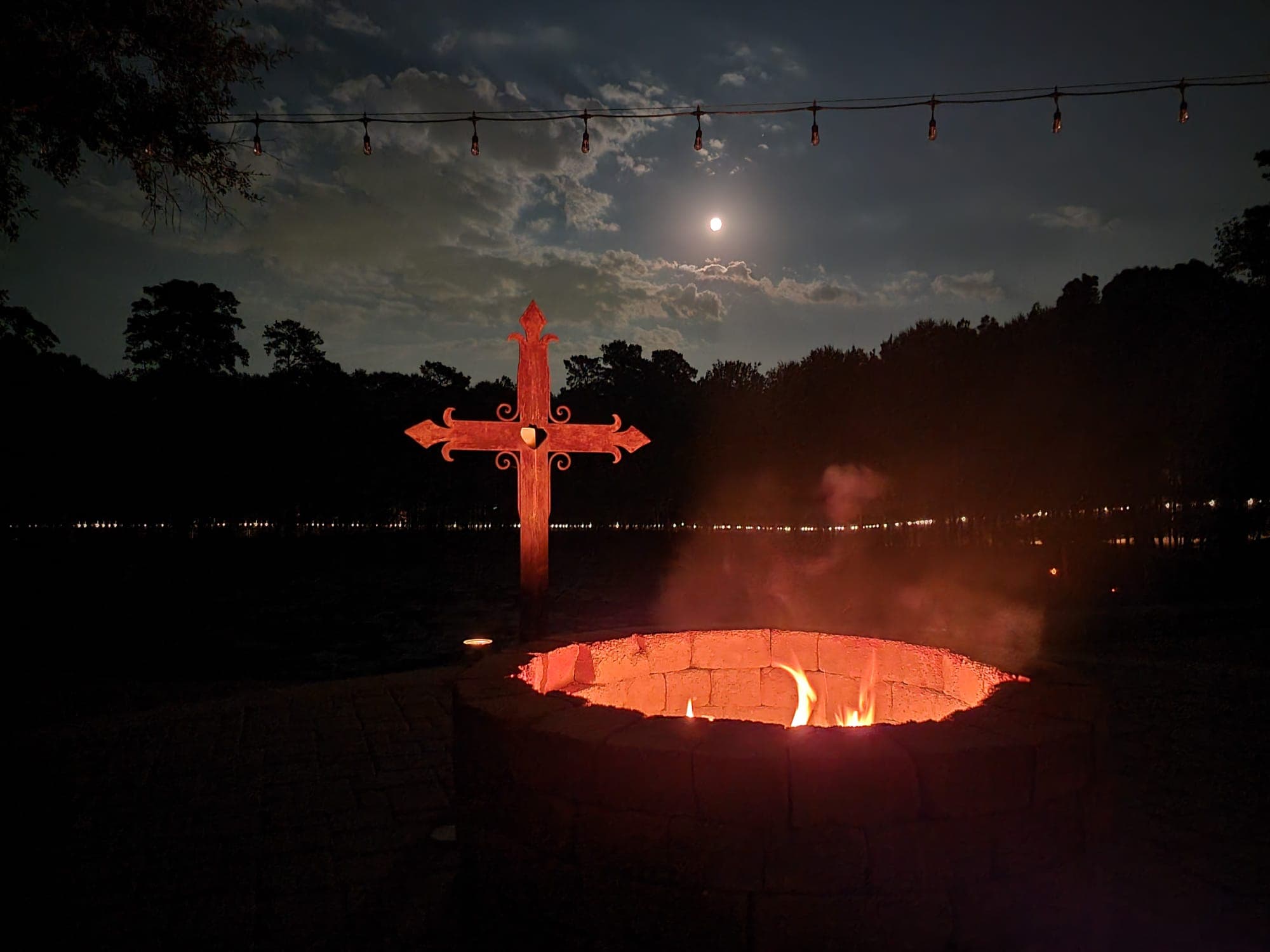
At Camp Deo Gratias, we have established an outdoor Stations of the Cross path on our grounds, winding through the natural beauty of our property. Walking the Stations outdoors, surrounded by the sights and sounds of creation, adds a dimension that the indoor experience cannot fully replicate. The physical effort of walking, the fresh air, the changing light—all of these elements deepen the experience of prayer and help the faithful to enter more fully into the mystery of Christ's suffering.
Privately
The Stations of the Cross can also be walked privately, at any time. You do not need a priest, a group, or even a set of stations. You can meditate on the stations using a prayer book, a pamphlet, or even from memory. Some people walk the Stations in their homes, moving from room to room, or simply sit in one place and journey through the stations in their imagination. The important thing is not the external form but the interior disposition—the willingness to accompany Christ on His journey to Calvary and to open your heart to the graces that flow from meditation on His Passion.
A Meditative Journey Through the Fourteen Stations
What follows is a reflection on each of the fourteen traditional stations, inviting you to enter into the mystery of Christ's Passion and to find in each station a word of grace for your own life.
The First Station: Jesus Is Condemned to Death
Pilate, having found no guilt in Jesus, yields to the pressure of the crowd and sentences the innocent Man to death by crucifixion. The judge of all the earth stands before a human judge, silent and unresisting. He who could have summoned legions of angels to His defense (Matthew 26:53) instead accepts the unjust verdict with the quiet dignity of a lamb led to slaughter (Isaiah 53:7).
In this station, we contemplate the mystery of divine submission. Jesus, the Lord of all creation, allows Himself to be judged by His own creatures. He accepts condemnation so that we might be set free. He takes upon Himself the verdict that our sins deserve so that we might receive the acquittal of His grace. When we face unjust treatment, misunderstanding, or false accusation, this station invites us to unite our suffering with Christ's and to trust that God's justice will prevail, even when human justice fails.
The Second Station: Jesus Takes Up His Cross
The heavy wooden cross is laid upon the shoulders of Jesus, and He embraces it—not with resignation but with love. The cross is the instrument of His torture and death, yet He takes it up willingly, knowing that through it, the salvation of the world will be accomplished. "If anyone wishes to come after me, he must deny himself and take up his cross daily and follow me" (Luke 9:23).
Every human life carries its cross—sickness, loss, disappointment, failure, loneliness, and the daily struggle against sin. This station reminds us that we do not carry our crosses alone. Christ has gone before us, bearing the heaviest cross of all, and He walks beside us in our suffering. The cross, which seems to be the sign of defeat, is in reality the throne of divine love.
The Third Station: Jesus Falls the First Time
Under the crushing weight of the cross, weakened by the scourging and the crown of thorns, Jesus stumbles and falls to the ground. The onlookers stare; the soldiers shout. The Son of God lies in the dust of a Jerusalem street, His face pressed against the stones.
This station speaks to our own falls and failures. We all stumble on the path of discipleship. We all make promises we cannot keep, commit sins we swore we would never repeat, and find ourselves face-down in the dust of our own weakness. But the message of this station is not about the fall; it is about what happens next. Jesus gets up. He rises from the dust and continues on His way. And so must we. No fall is final for the soul that trusts in God's mercy. The grace of God is always sufficient to raise us up and set us back on the path.
The Fourth Station: Jesus Meets His Mother
Along the road to Calvary, Jesus encounters His Blessed Mother. Their eyes meet—the eyes of the Son who is giving His life for the world, and the eyes of the Mother whose heart is being pierced by the sword that Simeon foretold (Luke 2:35). No words are recorded; none are needed. In this exchange of glances, a universe of love and sorrow is communicated.
Mary's presence on the Via Dolorosa is a testament to the power of faithful love. She cannot take away her Son's suffering, but she can be present to Him in it. She can walk beside Him, share His pain, and offer the comfort of her love. This station reminds us of the importance of being present to those who suffer—not necessarily with answers or solutions, but simply with our presence, our compassion, and our love.
The Fifth Station: Simon of Cyrene Helps Jesus Carry the Cross
The Roman soldiers, perhaps fearing that Jesus will die before reaching Golgotha, seize a man from the crowd—Simon, a native of Cyrene in North Africa—and compel him to help carry the cross (Matthew 27:32). Simon does not volunteer for this task; it is forced upon him. Yet tradition tells us that this reluctant helper became a believer, and his sons Alexander and Rufus became known members of the early Christian community (Mark 15:21).
This station teaches us that sometimes grace comes to us in the form of unwanted burdens. The crosses we do not choose—the responsibilities thrust upon us, the demands we did not anticipate, the suffering we would never have selected—can become the very means of our salvation. It also reminds us that we are called to help others carry their crosses. The Christian life is not lived in isolation; it is lived in solidarity, bearing one another's burdens and so fulfilling the law of Christ (Galatians 6:2).
The Sixth Station: Veronica Wipes the Face of Jesus
According to an ancient tradition, a woman named Veronica breaks through the crowd and wipes the sweat and blood from the face of Jesus with her veil. When she looks at the veil afterward, she finds the image of Christ's face miraculously imprinted upon it. The name "Veronica" itself is sometimes understood as a combination of the Latin word "vera" (true) and the Greek word "eikon" (image)—the "true image."
This station celebrates the courage of compassion. While others stood by in fear or indifference, Veronica acted. Her act of kindness was small—a gesture of tenderness in the midst of unspeakable brutality—but it left an indelible mark, both on the veil and on the memory of the Church. This station reminds us that every act of compassion, no matter how small, is a participation in the love of God and leaves a lasting impression on the world.
The Seventh Station: Jesus Falls the Second Time
Again, Jesus falls under the weight of the cross. The journey is only half completed, and His strength is failing. The crowd presses in; the soldiers grow impatient. Yet again, He rises. Again, He takes up the cross and continues His journey.
This second fall speaks to the persistence required in the spiritual life. The path to holiness is not a steady, uninterrupted ascent; it is marked by repeated falls and renewed beginnings. The saints understood this well. Saint Josemaria Escriva wrote that a saint is not someone who never falls, but someone who always gets up. This station encourages us to persevere in the face of repeated failure, trusting that God's grace is greater than our weakness.
The Eighth Station: Jesus Speaks to the Women of Jerusalem
A group of women along the road weep for Jesus, moved by the sight of His suffering. But Jesus turns to them and says, "Daughters of Jerusalem, do not weep for me; weep instead for yourselves and for your children" (Luke 23:28). Even in His agony, Jesus is thinking of others, warning them of the consequences of sin and calling them to repentance.
This station challenges us to look beyond the surface of things and to recognize the deeper spiritual realities at work in our world. Jesus does not reject the women's compassion, but He redirects it. He wants them to weep not merely over His physical suffering but over the sin that makes such suffering necessary. This station invites us to a deeper sorrow for sin—our own and the world's—and to the conversion of heart that such sorrow can bring about.
The Ninth Station: Jesus Falls the Third Time
A third time, Jesus falls. Three times, He has been brought low by the weight of the cross and the frailty of His human body. Three times, He has risen and continued on His way. This third fall, coming so close to Golgotha, is perhaps the most agonizing of all. Everything within Him must cry out for relief, for rest, for the end of this terrible journey.
This station speaks powerfully to those who feel they have reached the end of their strength—who have fallen so many times that they wonder if it is worth getting up again. The answer of the Cross is always yes. No matter how many times we fall, no matter how deep our weakness, the grace of God is sufficient. Christ fell three times so that we might know that He understands our struggles, and so that we might find in His example the courage to rise again, no matter what.
The Tenth Station: Jesus Is Stripped of His Garments
Upon reaching Calvary, the soldiers strip Jesus of His garments, exposing Him to the mockery of the crowd and the shame of total vulnerability. The seamless tunic, which tradition says was woven by His mother's hands, is taken from Him and divided among the soldiers, who cast lots for it (John 19:23-24). Jesus, who clothed the universe in beauty, stands naked and exposed before the eyes of the world.
This station speaks to our fear of vulnerability and exposure. We all wear garments of self-protection—masks of competence, respectability, and control—to hide our true selves from the world. Jesus allows Himself to be stripped of all protection, all dignity, all pretense. He stands before us in utter nakedness, revealing the depth of His love and the completeness of His self-gift. This station invites us to let go of our own pretenses and to stand before God in honesty and humility, trusting that His love is not diminished by our weakness but is, in fact, most powerful in our vulnerability.
The Eleventh Station: Jesus Is Nailed to the Cross
The soldiers lay Jesus upon the cross and drive nails through His hands and feet. The sound of the hammer rings out over Golgotha—each blow a testimony to the cruelty of sin and the depth of divine love. Jesus, who stretched out His hands to heal the sick, bless the children, and break bread with sinners, now stretches out His hands to be nailed to the wood of the Cross.
This station invites us to contemplate the cost of our redemption. Each nail is driven by our sins—by our selfishness, our pride, our cruelty, our indifference. Yet each nail is also an expression of divine love, for Jesus freely chose to endure this suffering for our sake. "No one takes my life from me," He said. "I lay it down on my own" (John 10:18). This station calls us to gratitude—a gratitude that is not merely emotional but that transforms the way we live, inspiring us to respond to such love with our whole hearts.
The Twelfth Station: Jesus Dies on the Cross
After three hours of agony, darkness covers the land, and Jesus cries out with a loud voice, "Father, into your hands I commend my spirit" (Luke 23:46). And with these words, He breathes His last. The Creator of the universe dies. The Source of all life gives up His life. The eternal Word falls silent. The veil of the Temple is torn in two from top to bottom, the earth quakes, and the centurion standing at the foot of the Cross declares, "Truly this man was the Son of God" (Mark 15:39).
This is the center of the Christian faith, the moment upon which all of history turns. In the death of Jesus, sin is defeated, death is conquered, and the gates of heaven are thrown open. What appeared to be the ultimate tragedy is revealed as the ultimate triumph of love over hate, life over death, mercy over judgment. This station invites us to kneel in silence before the Cross, to let the reality of what God has done for us penetrate our hearts, and to respond with the awe and gratitude that such love demands.
The Thirteenth Station: Jesus Is Taken Down from the Cross
The body of Jesus is taken down from the Cross and placed in the arms of His Mother. The scene is captured in countless works of art—the Pieta—and it never fails to move the heart. Mary, who held the infant Jesus in her arms at Bethlehem, now holds the lifeless body of her adult Son. The joy of the Nativity gives way to the sorrow of the Deposition, and yet, even in this darkest moment, there is a tenderness and a beauty that speak of indestructible love.
This station speaks to all who grieve, to all who have held the body of a loved one and felt the weight of loss. Mary's sorrow is our sorrow; her grief is our grief. But even in the darkness of death, faith whispers that this is not the end. The seed that falls into the ground and dies will bear much fruit (John 12:24). The sorrow of Good Friday will give way to the joy of Easter Sunday. This station invites us to trust in God's promise, even when all seems lost, and to entrust our dead to the merciful hands of the God who conquers death.
The Fourteenth Station: Jesus Is Laid in the Tomb
The body of Jesus is wrapped in a clean linen cloth and laid in a new tomb, hewn from rock, in which no one has yet been buried (Matthew 27:59-60). A great stone is rolled across the entrance, and the soldiers stand guard. The world is silent. The disciples are scattered. All hope seems extinguished.
And yet, within the darkness of the tomb, something is happening that no human eye can see. The power of God is at work in the silence, preparing the greatest miracle in the history of the world. The tomb is not the end of the story; it is the prelude to the Resurrection. This final station reminds us that God's greatest works are often accomplished in hiddenness and silence, in the places where we least expect them. It invites us to trust that even when our lives feel like a tomb—dark, enclosed, and seemingly without hope—God is at work, preparing a dawn that will exceed our wildest imaginings.
Walking the Way of the Cross Today
The Stations of the Cross are not a relic of the past; they are a living devotion that speaks powerfully to the contemporary world. In a culture that avoids suffering at all costs, the Way of the Cross teaches us that suffering, when united with Christ's, has meaning and redemptive power. In a world that prizes comfort and convenience, the Way of the Cross invites us to embrace the hard, narrow path that leads to life.
Whether you walk the Stations in a church, along an outdoor path, or in the quiet of your own home, we invite you to make this ancient devotion a regular part of your spiritual life—especially during the holy season of Lent. Let the story of Christ's Passion penetrate your heart. Let His suffering speak to your suffering. Let His love transform your love. And let the Way of the Cross lead you, as it has led countless faithful souls before you, from the darkness of Calvary to the radiant light of the empty tomb.
"We adore you, O Christ, and we praise you, because by your holy Cross you have redeemed the world."