Lectio Divina: The Ancient Art of Sacred Reading
In the quiet of a medieval monastery, a monk sits in his cell with a copy of the Psalms open before him. He reads slowly, savoring each word, allowing the sacred text to wash over him like water over stones in a stream. He pauses at a phrase that strikes his heart, repeats it softly, turns it over in his mind, and lets it descend from his intellect into the depths of his soul. He begins to speak to God about what he has read—not in formal prayers or rehearsed formulas, but in the simple, spontaneous language of a child speaking to a beloved Father. And then, almost imperceptibly, the words fall away, and he finds himself resting in a silence that is not empty but full—full of the presence of the One who has spoken to him through the sacred text.
This is Lectio Divina—literally, "divine reading" or "sacred reading"—and it is one of the most ancient, most treasured, and most transformative forms of prayer in the Catholic tradition. For more than fifteen hundred years, monks, nuns, and laypeople have practiced Lectio Divina as a way of encountering God through the inspired words of Sacred Scripture. It is not Bible study, though it involves reading the Bible. It is not theological analysis, though it engages the intellect. It is prayer—a living conversation between the human soul and the God who speaks through His Word.
In our age of information overload, where we consume words at a dizzying pace and rarely pause to digest what we have read, Lectio Divina offers a radical alternative. It invites us to slow down, to read less in order to receive more, and to approach the sacred text not as a problem to be solved or a lesson to be learned but as a love letter from God, written to us personally, here and now. This article offers a comprehensive exploration of Lectio Divina—its monastic origins, its classical structure, its spiritual fruits, and practical guidance for integrating it into your daily life.
The Monastic Origins of Lectio Divina
The Desert Fathers and Mothers
The roots of Lectio Divina reach back to the very origins of Christian monasticism. In the third and fourth centuries, men and women withdrew from the cities of the Roman Empire to the deserts of Egypt, Palestine, and Syria, seeking God in solitude, silence, and prayer. These Desert Fathers and Mothers, as they came to be known, lived lives of radical simplicity, devoting themselves to manual labor, fasting, and above all, the continual reading and meditation of Sacred Scripture.
For these early monks, the Bible was not merely a text to be studied; it was food for the soul. They spoke of "ruminating" on Scripture—chewing on the words slowly and repeatedly, like a cow chewing its cud—allowing the sacred text to nourish and transform them from within. This practice of slow, meditative, prayerful reading of Scripture was the seedbed from which Lectio Divina would grow.
Saint Benedict and the Benedictine Tradition
The formal practice of Lectio Divina received its definitive shape within the Benedictine monastic tradition. Saint Benedict of Nursia (c. 480–547), the father of Western monasticism, placed the reading of Scripture at the heart of monastic life. In his Rule, Benedict prescribed specific hours each day for Lectio Divina, understanding that the prayerful reading of God's Word was essential for the monk's spiritual growth and for the health of the monastic community.
For Benedict, Lectio Divina was not an academic exercise but a spiritual practice—a way of allowing the Word of God to penetrate the heart and transform the will. The monk was to read slowly, attentively, and with the expectation of encountering the living God in the text. This reading was not merely intellectual; it engaged the whole person—mind, heart, and will—and it was oriented toward a personal encounter with Christ, the Word made flesh.
Guigo II and the Four Steps
In the twelfth century, a Carthusian monk named Guigo II wrote a short but profoundly influential text called "The Ladder of Monks" (Scala Claustralium), in which he articulated the four classical steps of Lectio Divina. Guigo compared the spiritual life to a ladder with four rungs, each one leading the soul higher into communion with God:
1. **Lectio** (Reading): Taking up the sacred text and reading it slowly and attentively. 2. **Meditatio** (Meditation): Reflecting on the text, turning it over in the mind, and seeking to understand its meaning. 3. **Oratio** (Prayer): Responding to the text in prayer—speaking to God about what one has read and heard. 4. **Contemplatio** (Contemplation): Resting in God's presence, beyond words and thoughts, in silent communion with the divine.
Guigo described these four steps with a beautiful analogy: "Reading is, as it were, putting food into the mouth; meditation is chewing it; prayer is savoring it; and contemplation is the sweetness that delights and refreshes." This fourfold structure has remained the classical framework for Lectio Divina ever since, though practitioners across the centuries have adapted and expanded it in various ways.
The Four Steps of Lectio Divina in Detail
Step One: Lectio (Reading)
The first step of Lectio Divina is simply to read the sacred text. But this reading is fundamentally different from the way we typically read. In our daily lives, we tend to read quickly, scanning for information, looking for the main point, and moving on as soon as we have grasped it. Lectio asks us to do the opposite: to read slowly, deliberately, and with complete attention, as if every word mattered—because in Sacred Scripture, every word does matter.
When beginning Lectio Divina, choose a passage of Scripture. It need not be long; a few verses are often sufficient. Many practitioners use the readings from the daily Mass, a passage from one of the Gospels, or a Psalm. Begin with a brief prayer asking the Holy Spirit to open your heart and mind to receive God's Word. Then read the passage slowly, perhaps aloud, allowing each word and phrase to register fully. You are not reading for information; you are reading for encounter.
As you read, pay attention to any word, phrase, or image that strikes you—that seems to "light up" or to speak to you in a particular way. This is often described as the text "choosing" you, rather than you choosing the text. You may not be able to explain why a particular word or phrase catches your attention; it may seem insignificant or even unrelated to your present circumstances. Trust the process. The Holy Spirit is at work, guiding your attention to the word that God wishes to speak to you today.
Step Two: Meditatio (Meditation)
Once a word, phrase, or image from the text has caught your attention, the second step is to meditate on it—to turn it over in your mind, to ponder it from different angles, to explore its meaning and significance. This is not academic analysis but an active engagement of the heart and mind with the sacred text.
You might ask yourself questions: What does this word or phrase mean? Why does it strike me? What is God trying to say to me through it? How does it connect to my life, my struggles, my joys, my relationships? What does it reveal about God's character, His love, His will? You are not trying to produce a theological treatise; you are trying to let the Word of God penetrate more deeply into your heart.
The medieval monks compared this step to chewing food. Just as chewing breaks down food so that it can be digested and assimilated by the body, so meditation breaks open the sacred text so that its spiritual nourishment can be absorbed by the soul. Take your time with this step. There is no rush. If you spend your entire prayer time meditating on a single word, that is perfectly fine. Depth is more important than breadth in Lectio Divina.
Step Three: Oratio (Prayer)
The third step is prayer—the response of the heart to what it has heard in the sacred text. Having read God's Word and meditated on its meaning, you now speak to God about what you have received. This prayer can take many forms: praise, thanksgiving, petition, intercession, repentance, surrender, or simply the expression of love.
The key characteristic of Oratio is that it is personal and spontaneous. It is not the recitation of a formula but a genuine conversation with God. You are responding to what He has said to you in the text, much as you would respond to a friend who has shared something important with you. If the text has revealed God's mercy, you might respond with gratitude and praise. If it has convicted you of a fault, you might respond with repentance and a plea for grace. If it has stirred your heart with love, you might simply tell God that you love Him and want to follow Him more closely.
Saint Therese of Lisieux described prayer as "a surge of the heart, a simple look turned toward heaven, a cry of recognition and love." Oratio is precisely this kind of prayer—not elaborate or sophisticated, but direct, honest, and heartfelt. It is the voice of the soul responding to the voice of God.
Step Four: Contemplatio (Contemplation)
The fourth and final step of Lectio Divina is contemplation—a resting in God's presence that goes beyond words, thoughts, and images. If Lectio is the mouth receiving food, Meditatio is the chewing, and Oratio is the savoring, then Contemplatio is the nourishment itself—the moment when the spiritual food becomes part of us, when the Word of God takes up residence in the depths of our being.
Contemplation cannot be forced or manufactured. It is a gift of grace, and it comes in God's time, not ours. Some days, contemplation may come easily; other days, it may not come at all. When it does come, it is typically experienced as a deep sense of peace, joy, and union with God—a sense that words are no longer necessary because the heart has found what it was seeking. You may feel nothing dramatic; it may simply be a quiet settling of the soul, a resting in the knowledge that you are loved.
When contemplation does not come, do not be discouraged. Simply remain in the posture of openness and receptivity, content to be in God's presence whether or not you feel His consolation. The saints teach us that the prayer of simple presence—being with God without any agenda, any demand, or any expectation—is itself a profound act of love and a powerful form of prayer.
Practical Guidance for Practicing Lectio Divina
Preparing Your Space
Create a physical environment that supports prayerful reading. Choose a quiet place where you will not be interrupted—a chapel, a corner of your home dedicated to prayer, a garden, or any setting where you can be still. You might light a candle, place a crucifix or icon in view, and have your Bible open and ready. These small acts of preparation signal to your body and mind that you are entering a sacred time and space.
Choosing a Text
For beginners, the Gospels are an excellent starting point for Lectio Divina. The words and actions of Jesus are the heart of Sacred Scripture, and they lend themselves naturally to meditative reading. The Psalms are also wonderful texts for Lectio Divina, as they express the full range of human emotion—praise, lament, joy, grief, trust, and longing—in the context of a relationship with God. You might also use the daily Mass readings, which provide a structured way to encounter Scripture throughout the liturgical year.
Whatever text you choose, keep it short. Lectio Divina is not about covering ground; it is about going deep. A few verses are usually sufficient. You can always read more if you feel called to, but it is better to begin with less and discover depth than to begin with more and remain on the surface.
How Long Should Lectio Divina Take?
There is no set length for Lectio Divina. The classical monastic tradition prescribed extended periods of sacred reading each day—sometimes two or three hours—but for most laypeople, a more realistic commitment might be fifteen to thirty minutes daily. The important thing is regularity, not duration. A consistent daily practice of fifteen minutes will bear more fruit than an occasional marathon session.
That said, be flexible. Some days, you may find yourself drawn to spend more time in one step than in another. You may spend most of your time in meditation on a single phrase, or you may find yourself quickly drawn into contemplation. Let the Holy Spirit guide your prayer rather than rigidly adhering to a timetable.
Common Challenges and How to Address Them
**Distractions.** Just as in any form of prayer, distractions are inevitable during Lectio Divina. Your mind will wander to your to-do list, your worries, your plans for the day. When this happens, gently and without self-reproach, bring your attention back to the text or to the word or phrase you are meditating on. Some practitioners find it helpful to write down the distracting thought on a piece of paper and set it aside, symbolically entrusting it to God so that they can return to their prayer.
**Dryness.** There will be days when the text seems flat, when no word or phrase jumps out at you, when prayer feels like a chore rather than a delight. This is normal and is not a sign that you are doing something wrong. The spiritual life includes periods of dryness and consolation, and both are valuable. During dry times, simply remain faithful to the practice, trusting that God is at work even when you cannot feel His presence. The Carmelite tradition speaks of the "dark night of the soul" as a period of purification in which God draws us beyond the consolations of prayer to a deeper, more mature faith.
**The temptation to analyze.** Those with theological training or an intellectual bent may find it tempting to turn Lectio Divina into Bible study—parsing Greek words, comparing translations, and constructing arguments. While there is a place for scholarly study of Scripture, Lectio Divina is not that place. In Lectio, the goal is not to understand the text intellectually but to be transformed by it spiritually. If you find yourself slipping into analytical mode, gently redirect your attention to the devotional dimension of the text and ask the Holy Spirit to speak to your heart, not just your mind.
**Feeling "unqualified."** Some people feel that Lectio Divina is only for monks, nuns, or advanced pray-ers, and that ordinary laypeople are not ready for it. This is emphatically not the case. Lectio Divina is for everyone. The Second Vatican Council urged all the faithful to develop a love for Sacred Scripture, and Lectio Divina is one of the most accessible and rewarding ways to do so. You do not need a degree in theology or decades of prayer experience. You need only a Bible, a willing heart, and a few minutes of quiet.
The Spiritual Fruits of Lectio Divina
Those who practice Lectio Divina faithfully over time consistently report certain spiritual fruits.
**A deeper love for Scripture.** When we read the Bible prayerfully and attentively, it ceases to be a distant, ancient text and becomes a living Word that speaks to us personally. Over time, we develop an intimate familiarity with Scripture that enriches every aspect of our spiritual lives—our prayer, our worship, our understanding of God, and our discernment of His will.
**A more personal relationship with God.** Lectio Divina is fundamentally relational. It is not about acquiring knowledge or checking a box; it is about encountering a Person. As we engage with God's Word in this prayerful way, our relationship with Him deepens and becomes more intimate. We begin to recognize His voice more readily, to trust His promises more fully, and to love Him more ardently.
**Greater peace and stability.** The practice of Lectio Divina has a centering and stabilizing effect on the soul. In a world that is constantly changing and often chaotic, the Word of God is an anchor that holds us firm. The regular practice of sacred reading grounds us in the eternal truths of the faith and gives us the inner stability we need to navigate the challenges of daily life.
**Transformation of character.** The ultimate goal of Lectio Divina is not knowledge but transformation—the gradual conformity of our hearts and lives to the image of Christ. As we dwell in God's Word and allow it to dwell in us, we are changed from within. The virtues of Christ—humility, patience, compassion, courage, generosity, and love—begin to take root in our hearts and manifest in our actions.
Lectio Divina and the Liturgical Year
One of the most rewarding ways to practice Lectio Divina is to allow it to be shaped by the rhythms of the liturgical year. The Church, in her wisdom, has arranged the cycle of Scripture readings so that the faithful encounter the full sweep of salvation history over the course of each year. By using the daily Mass readings as your text for Lectio Divina, you align your personal prayer with the prayer of the universal Church and enter more deeply into the particular season or feast being celebrated.
During Advent, for example, the readings are filled with themes of expectation, longing, and preparation. Practicing Lectio Divina with these texts can deepen your own experience of waiting for the Lord and help you enter more fully into the spiritual preparation for Christmas. During Lent, the readings focus on repentance, conversion, and the journey toward the Cross. Lectio Divina with these texts can become a powerful tool for spiritual examination and renewal. During the Easter season, the readings overflow with joy, hope, and the transforming power of the Resurrection. Lectio Divina with these texts can fill you with the same joy that filled the first disciples when they encountered the risen Lord.
The liturgical year also brings us into contact with the lives of the saints, whose feast days are celebrated throughout the calendar. Many of these celebrations include readings that relate to the particular saint's life and charism. Practicing Lectio Divina with these readings can introduce you to the rich diversity of Catholic holiness and inspire you to follow the example of those who have gone before us in faith.
By weaving your practice of Lectio Divina into the liturgical year, you ensure that your prayer is not merely a private exercise but a participation in the great prayer of the Church. You join your voice to the chorus of believers around the world who are reading, meditating on, and praying with the same sacred texts on the same days, united in the one Body of Christ. This communion in the Word is one of the hidden treasures of the Catholic spiritual life, and Lectio Divina is the key that unlocks it.
Lectio Divina in Community
While Lectio Divina is often practiced individually, it can also be a powerful communal experience. In many parishes, monasteries, and retreat centers, groups gather to practice Lectio Divina together. Typically, the text is read aloud several times, with periods of silence between each reading. Participants may be invited to share the word or phrase that struck them, or to share briefly how the text spoke to them. The practice concludes with shared prayer.
Communal Lectio Divina adds a dimension that individual practice cannot: the experience of hearing how the same text speaks to different hearts in different ways. This sharing enriches everyone's understanding of the text and of the God who speaks through it. It also builds community, as participants share their faith and their vulnerabilities in a context of prayer and mutual respect.
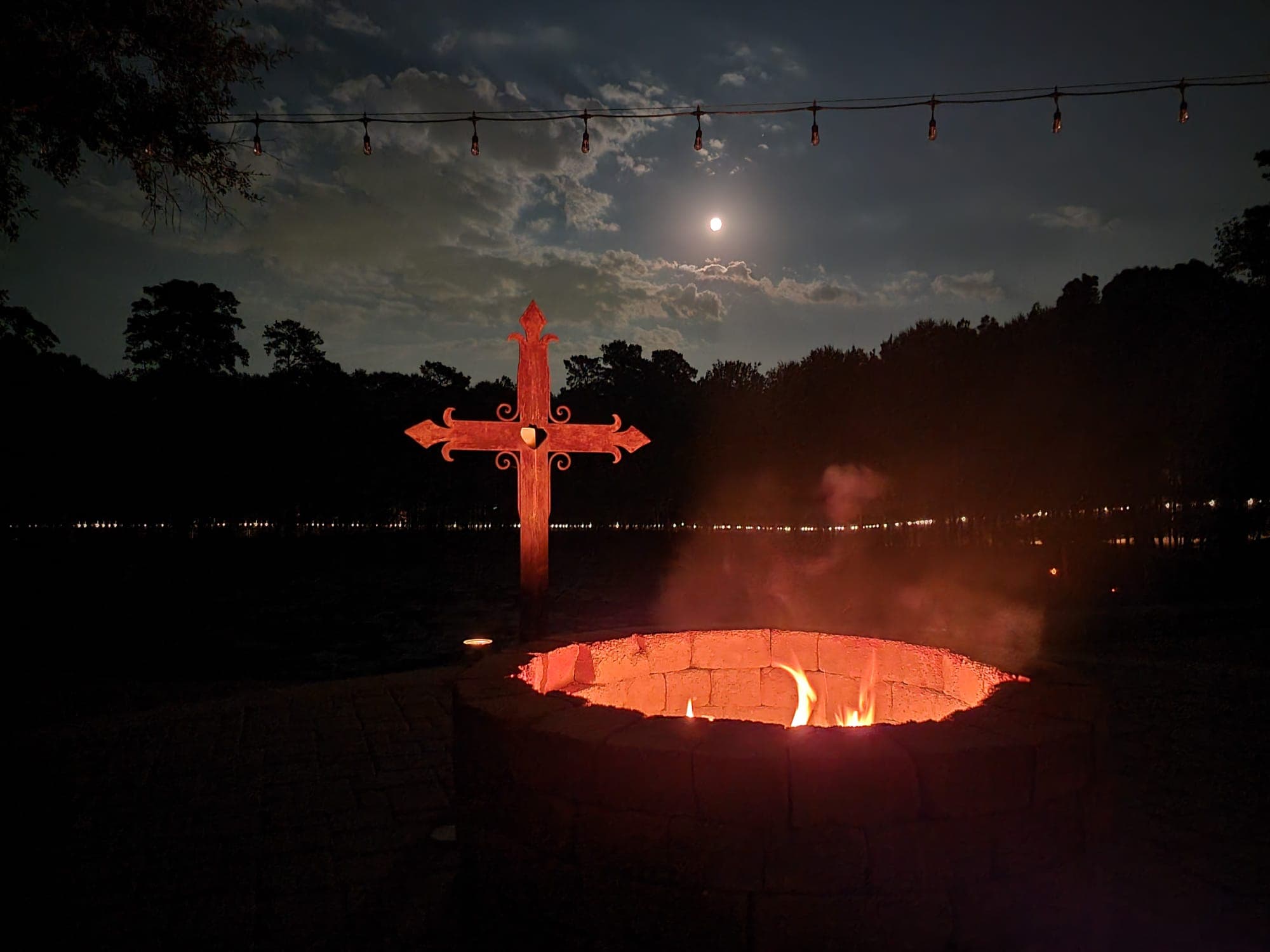
At Camp Deo Gratias, we regularly incorporate communal Lectio Divina into our retreats and programs. Whether gathered in a chapel, seated around a campfire, or spread out on a hillside, our guests have the opportunity to encounter God's Word together and to share the fruits of their prayer. These experiences of communal Lectio are often among the most memorable and transformative moments of our retreats.
"Your word is a lamp for my feet, a light for my path." — Psalm 119:105
The Word of God is indeed a lamp—a light that illuminates the path before us, reveals the truth about ourselves and about God, and guides us safely through the darkness of this world toward the eternal light of heaven. Lectio Divina is the practice of holding up that lamp, of opening ourselves to its light, and of allowing it to transform us from the inside out. We invite you to take up this ancient and holy practice and to discover for yourself the inexhaustible riches that await you in the pages of Sacred Scripture.