In the vast treasury of Catholic spirituality, few practices have proven as enduringly fruitful as the Examen. Developed by St. Ignatius of Loyola in the sixteenth century, this deceptively simple prayer has guided countless souls toward a deeper awareness of God's presence in the ordinary moments of daily life. Whether you are a seasoned contemplative or someone just beginning to explore the riches of Catholic prayer, the Examen offers a practical, accessible, and profoundly transformative path to discernment and spiritual growth.
St. Ignatius himself considered the Examen so essential that he instructed his fellow Jesuits never to omit it, even if they had to set aside other prayers. He understood that this brief daily review, typically lasting fifteen to twenty minutes, could accomplish what hours of unfocused prayer might not: a genuine encounter with the living God in the concrete circumstances of one's own life. For Ignatius, the Examen was not merely an exercise in self-reflection but a privileged moment of divine communication, a time when the Holy Spirit illuminates the movements of the heart and reveals the deeper currents of grace flowing through every human experience.
The Historical Context of Ignatian Spirituality
To appreciate the Examen fully, it helps to understand the man who developed it and the spiritual tradition from which it emerged. Inigo Lopez de Loyola was born in 1491 in the Basque region of Spain. A soldier and courtier by temperament and training, his life was dramatically redirected when a cannonball shattered his leg during the Battle of Pamplona in 1521. During his long convalescence, deprived of the romances he preferred to read, Ignatius turned to the only books available: a life of Christ and a collection of saints' lives.
What happened during those months of recovery would change the course of Christian spirituality. Ignatius began to notice something remarkable about his inner life. When he daydreamed about worldly glory and romantic conquests, he felt an initial surge of excitement that quickly faded into emptiness and restlessness. But when he imagined himself following in the footsteps of St. Francis and St. Dominic, performing great acts of penance and service for God, he experienced a deep, lasting joy and peace that remained even after the daydream ended. This observation became the seed of what Ignatius would later call the discernment of spirits, the foundational principle underlying the Examen and all of Ignatian spirituality.
Over the following years, Ignatius refined his insights through intense prayer, study, and spiritual direction. He spent nearly a year in the cave at Manresa, where he experienced profound mystical graces and began composing the Spiritual Exercises, the masterwork that would become one of the most influential texts in the history of Christian spirituality. The Exercises are essentially a structured retreat program designed to help individuals encounter God personally and discern His will for their lives. The Examen, while part of this larger framework, stands on its own as a daily practice accessible to anyone seeking to grow in awareness of God's action in their life.
Ignatius founded the Society of Jesus, commonly known as the Jesuits, in 1540. The order quickly became one of the most dynamic forces in the Catholic Church, establishing schools, universities, and missions across the globe. Central to Jesuit spirituality was the conviction that God could be found in all things, not only in explicitly sacred contexts but in the messiness and beauty of everyday human experience. The Examen is the practical expression of this conviction, a daily discipline of attention that trains the soul to recognize divine presence wherever it appears.
Understanding the Five Steps of the Examen
The traditional Examen follows a five-step structure, though various spiritual directors have adapted these steps over the centuries. The essential movement, however, remains consistent: from gratitude through honest review to hopeful surrender. Let us explore each step in depth.
Step One: Become Aware of God's Presence
The Examen begins not with self-analysis but with an act of faith. Before reviewing the events of the day, you pause to place yourself consciously in the presence of God. This is not a matter of generating a feeling but of acknowledging a reality. God is already present. He has been with you throughout the entire day, whether you noticed Him or not. This first step is an act of recollection, a gathering of your scattered attention and a deliberate turning of your heart toward the One who never turns away from you.
Practically, this might involve taking several slow, deep breaths. You might imagine God looking at you with love, or you might simply say a brief prayer such as, "Lord, You have been with me all day. Help me to see where You were at work." Some people find it helpful to light a candle or sit in a particular chair they have set aside for prayer. The external details matter less than the interior disposition: a willingness to be honest before God and a trust that He desires this encounter even more than you do.
"Where can I go from your Spirit? Where can I flee from your presence? If I go up to the heavens, you are there; if I make my bed in the depths, you are there." (Psalm 139:7-8)
This opening step also establishes the proper tone for everything that follows. The Examen is not an exercise in guilt or self-punishment. It takes place within the context of a loving relationship. God is not a stern auditor reviewing your accounts but a tender Father who wants to walk with you through the landscape of your day, pointing out things you might have missed and offering healing for the places where you stumbled.
Step Two: Review the Day with Gratitude
The second step invites you to look back over the day with eyes of gratitude. Ignatius placed enormous emphasis on gratitude because he recognized it as the fundamental response of the creature to the Creator. Ingratitude, he believed, was the root of all sin, the refusal to acknowledge that everything we have and are is gift.
In this step, you let the day replay in your memory, not as a rapid-fire summary but as a slow, attentive review. You notice the moments of beauty, kindness, and grace. Perhaps the morning light fell across your kitchen table in a way that momentarily took your breath away. Perhaps a colleague offered an unexpected word of encouragement. Perhaps you tasted your coffee and, for just a moment, really tasted it. Perhaps your child laughed, and the sound pierced your heart with joy.
Gratitude in the Examen is not limited to the obviously pleasant moments. With practice, you begin to notice grace at work even in difficult circumstances. The traffic jam that forced you to slow down might have prevented an accident. The challenging conversation with a friend might have revealed a truth you needed to hear. Even suffering, viewed through the lens of faith, can become an occasion for gratitude when we trust that God is working all things together for good.
"Give thanks in all circumstances; for this is God's will for you in Christ Jesus." (1 Thessalonians 5:18)
This practice of daily gratitude has profound psychological and spiritual effects. Research in positive psychology has confirmed what Ignatius intuited centuries ago: regularly attending to the good things in our lives rewires our brains for greater happiness, resilience, and compassion. But for the Christian, gratitude goes beyond psychological well-being. It is an act of worship, a recognition that every good gift comes from the Father of lights.
Step Three: Review the Emotions and Movements of the Day
This is the heart of the Examen and the step that most distinguishes it from a simple gratitude journal or daily review. Here, you pay attention not just to what happened during the day but to how you responded internally. What emotions arose in you? When did you feel most alive, most connected to God and others? When did you feel most drained, most disconnected, most turned in on yourself?
Ignatius used specific technical vocabulary for these interior movements. Consolation refers to any movement of the soul that draws it closer to God: experiences of faith, hope, love, joy, peace, compassion, generosity, and creative energy. Desolation refers to movements that pull the soul away from God: experiences of anxiety, despair, self-absorption, resentment, apathy, and spiritual dryness. Understanding these categories is essential for the practice of discernment.
It is important to note that consolation and desolation are not simply equivalent to feeling good or feeling bad. A person might experience consolation in the midst of grief if that grief draws them into deeper trust in God. Conversely, someone might experience desolation in the midst of worldly success if that success fuels pride and self-sufficiency. The key question is always directional: is this movement drawing me toward God or away from Him?
During this step, you move through the day like a pilgrim walking slowly through a landscape, pausing at the moments of strongest emotional resonance. You do not judge these emotions or try to explain them away. You simply notice them and present them to God. Often, patterns begin to emerge. You might notice that you consistently feel most alive when engaged in certain activities or with certain people. You might recognize that a particular recurring anxiety is connected to a deeper fear you have been avoiding.
Step Four: Choose One Feature of the Day and Pray About It
Having reviewed the full sweep of the day, you now focus your attention on one particular moment that stands out. This might be a moment of particular consolation that you want to savor and give thanks for. It might be a moment of desolation or sin that you want to bring before God for healing and forgiveness. It might be a puzzling or ambiguous moment that you want to explore with God's help.
This is the step where the Examen becomes most personal and most powerful. Here, you are not just thinking about your day; you are entering into dialogue with God about it. You might say, "Lord, why did I react so strongly when my coworker criticized my project? What was happening in my heart?" Or you might pray, "Thank You for that moment of connection with my daughter at dinner. Help me to be more present to her." Or you might confess, "I knew I should have spoken up when my friend was being treated unfairly, and I chose silence out of cowardice. Forgive me, and give me courage."
This step often involves the sacramental dimension of the Christian life. If the moment you focus on involves serious sin, the Examen might lead you to seek the Sacrament of Reconciliation. If it involves a deep experience of grace, it might inspire you to attend daily Mass in thanksgiving. The Examen does not replace the sacraments but naturally flows toward them, because it cultivates the kind of honest self-knowledge and God-awareness that makes sacramental encounters truly transformative.
"Search me, God, and know my heart; test me and know my anxious thoughts. See if there is any offensive way in me, and lead me in the way everlasting." (Psalm 139:23-24)
Step Five: Look Forward to Tomorrow with Hope
The Examen concludes not with a backward glance but with a forward gaze. Having reviewed the day just past, you now turn your attention to the day ahead. What do you anticipate? What challenges or opportunities are on the horizon? Where might you need special grace?
This is a moment of surrender and petition. You place the coming day in God's hands, asking for the specific graces you will need. If you noticed during your review that you were particularly impatient with a family member, you might ask for the grace of patience tomorrow. If you recognized a moment of genuine generosity, you might ask for the grace to build on it. If you are facing a difficult decision, you might ask for the gift of wisdom and clarity.
The forward-looking dimension of the Examen prevents it from becoming merely retrospective or self-absorbed. It is not spiritual navel-gazing but a practical preparation for mission. Each day is a new opportunity to cooperate with God's grace, and the Examen helps you approach that opportunity with greater intentionality and openness.
Close the prayer with a formal prayer such as the Our Father, a Hail Mary, or the Suscipe of St. Ignatius: "Take, Lord, and receive all my liberty, my memory, my understanding, and my entire will, all I have and call my own. You have given all to me. To you, Lord, I return it. Everything is yours; do with it what you will. Give me only your love and your grace, that is enough for me."
Practical Tips for Making the Examen a Daily Habit
Knowing the steps of the Examen is one thing; actually practicing it consistently is another. Here are some practical suggestions for incorporating this prayer into your daily life.
First, choose a specific time. Most people find that the evening, shortly before bed, works best, since you have a full day to review. However, some people prefer to pray the Examen during a lunch break, reviewing the morning, and then again before bed. Ignatius himself recommended praying it twice daily. The important thing is consistency. Choose a time and protect it.
Second, start small. If fifteen minutes feels overwhelming, begin with five. A brief, genuine Examen is infinitely more valuable than a long one you never actually pray. As the practice becomes habitual, you will naturally want to spend more time with it.
Third, find a method of recording your insights. Some people keep a spiritual journal in which they jot down key observations from their Examen. Others use a simple notebook or even a note-taking app on their phone. Recording your insights helps you notice patterns over time and provides material for conversations with a spiritual director.
Fourth, do not be discouraged by dryness or distraction. There will be days when the Examen feels mechanical or empty. This is normal and not a sign of failure. Persist through these dry periods with the confidence that God is working even when you cannot feel His presence. The discipline of showing up, day after day, is itself a powerful act of faith.
Fifth, consider praying the Examen with your spouse or family. Many couples have found that sharing their daily Examen, telling each other where they noticed God during the day, deepens their relationship and builds a shared spiritual vocabulary. Families with children can adapt the Examen into a simple bedtime ritual by asking questions like, "What was the best part of your day? What was the hardest part? Where did you see God today?"
The Examen and the Discernment of Spirits
The Examen is intimately connected to what Ignatius called the discernment of spirits, a sophisticated framework for understanding the interior movements that shape our decisions and our relationship with God. While a full treatment of Ignatian discernment is beyond the scope of this article, a brief overview will help situate the Examen within its larger spiritual context.
Ignatius believed that three different sources could produce interior movements: God, the enemy of our human nature, which he often called the evil spirit, and our own human nature with its complex mix of desires, fears, and habits. The work of discernment involves learning to distinguish among these sources so that we can cooperate with divine inspiration and resist temptation.
The evil spirit, Ignatius observed, typically works differently depending on the spiritual state of the person. For those who are moving away from God, the enemy encourages complacency by offering superficial pleasures and distractions. For those who are earnestly seeking God, the enemy employs a different strategy, stirring up anxiety, discouragement, false reasoning, and subtle temptations designed to derail the person's spiritual progress.
God, by contrast, works to strengthen, encourage, console, and inspire. His movements are characterized by peace, clarity, and an increase of faith, hope, and love. Even when God allows a soul to experience dryness or difficulty, there is an underlying sense of rightness and trust that distinguishes divine action from the desolation caused by the enemy.
The Examen trains us to notice these different movements in real time. Over weeks and months of faithful practice, we develop what might be called a spiritual palate, an increasingly refined ability to taste the difference between genuine grace and its counterfeits. This ability is not a special mystical gift reserved for saints and mystics. It is a practical skill that any sincere Christian can develop through patient practice.
The Examen in the Broader Catholic Tradition
While the Examen is distinctively Ignatian, it resonates deeply with the broader Catholic spiritual tradition. The practice of examining one's conscience has ancient roots, going back to the Desert Fathers and Mothers of the fourth and fifth centuries. The great monastic rules, including the Rule of St. Benedict, incorporated regular self-examination into the rhythm of daily life. The Examen as Ignatius developed it draws on this tradition while adding his distinctive emphasis on the discernment of interior movements.
The Examen also connects naturally to the Catholic practice of regular confession. By cultivating daily awareness of both sin and grace, the Examen prepares the soul for fruitful participation in the Sacrament of Reconciliation. Many spiritual directors recommend using insights from the Examen as material for confession, which ensures that the sacrament addresses the specific, concrete realities of one's spiritual life rather than remaining vague and generic.
Furthermore, the Examen supports and deepens every other form of prayer. Those who practice it regularly often find that their experience of the Mass becomes more personal and engaged, their lectio divina more fruitful, and their intercessory prayer more attuned to the real needs of others. Because the Examen cultivates awareness of God's presence in all things, it gradually transforms the entire fabric of one's spiritual life.
The Examen and the Camp Experience
For those of us involved in the ministry of Catholic camping and retreats, the Examen holds particular relevance. The camp environment, with its combination of natural beauty, community, and intentional spiritual programming, provides an ideal setting for introducing young people and families to this practice.
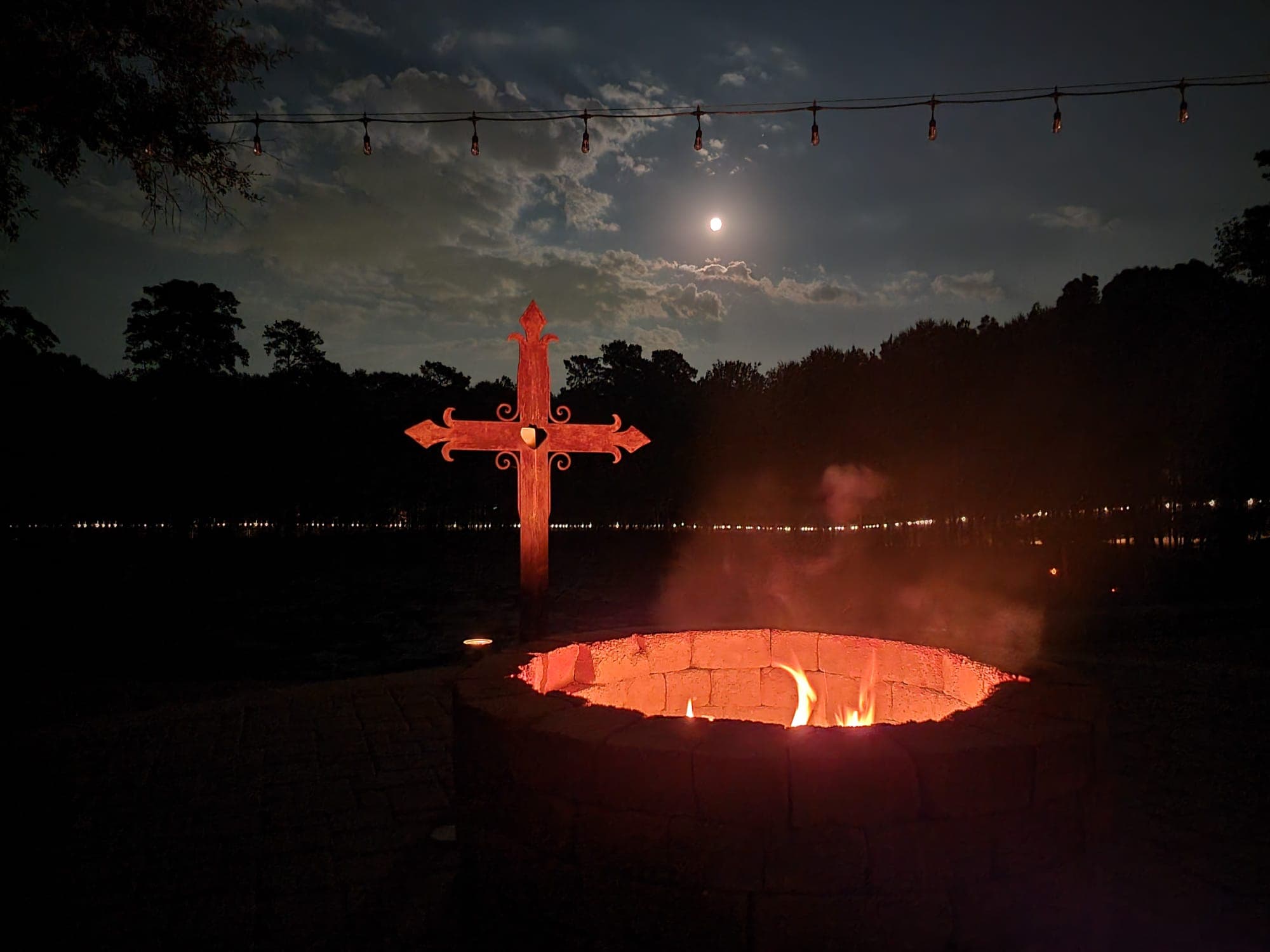
Imagine a group of campers gathered around a fire at the end of a full day of activities, canoeing, hiking, singing, praying, laughing, and learning. A camp counselor leads them through a simple version of the Examen. "Close your eyes and remember the day. Where did you feel most happy, most alive, most connected to God and to others? Where did you feel sad, frustrated, or alone? Talk to God about what you noticed." In that moment, around that fire, under those stars, young hearts are learning a practice that could sustain their faith for a lifetime.
The natural world itself becomes a powerful aid to the Examen in the camp setting. The beauty of a sunset over the lake, the quiet majesty of a forest trail, the awesome spectacle of a star-filled sky, all of these experiences awaken the soul to wonder and gratitude, which are precisely the dispositions the Examen seeks to cultivate. Many campers report that their most vivid experiences of God's presence occur not in the chapel but on the trail, at the waterfront, or around the campfire. The Examen helps them recognize and name these experiences as genuine encounters with the divine.
Living the Examined Life
Socrates famously declared that the unexamined life is not worth living. For the Christian, the examined life is not merely a philosophical ideal but a spiritual imperative. We are called to be attentive to the movement of the Holy Spirit in our hearts, to cooperate with grace, to resist temptation, and to grow daily in the knowledge and love of God. The Examen is one of the most powerful tools available to us in this lifelong endeavor.
As you begin or deepen your practice of the Examen, remember that it is not a test to be passed or a task to be completed. It is a conversation with Someone who loves you more than you can imagine. Approach it with honesty, humility, and hope. Trust that God will meet you in this prayer, even on the days when you feel nothing at all. And know that every evening you spend reviewing your day in the light of God's love, you are participating in a tradition of prayer that has sanctified souls for nearly five hundred years.
"Be still, and know that I am God." (Psalm 46:10)
The Examen invites us into a stillness that is not passive but deeply attentive, a stillness that listens for the voice of God in the joys and sorrows, the triumphs and failures, the ordinary and extraordinary moments of each irreplaceable day. May you find in this ancient practice a living wellspring of grace, discernment, and peace.